Logo-lien

Ici j'écrirai l'auteur

ici ce sera la notation

ici le sommaire

1 

2

3

4

5

6

7

8

9

10

11  

Analysis of concrete shrinkage, the induced self‑stresses, the differences with thermal effects, and the conditions for applying EC2 formula (7.21).

Calculation of concrete shrinkage effects

Analysis of concrete shrinkage, the induced self‑stresses, the differences with thermal effects, and the conditions for applying EC2 formula (7.21).

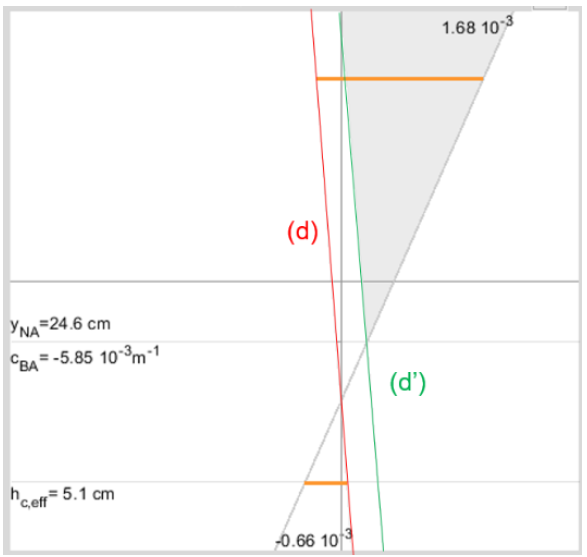
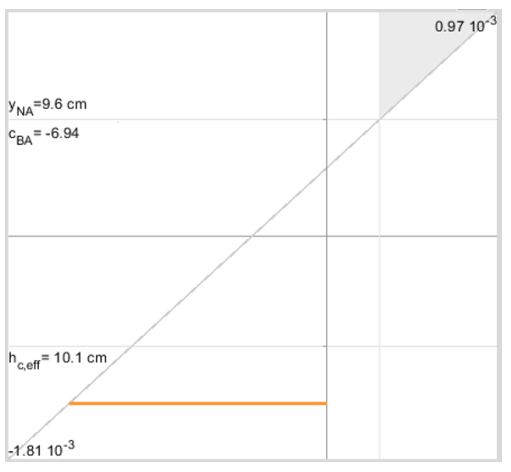
This article examines the mechanical behaviour of reinforced concrete subjected to shrinkage, highlighting the fundamental differences between shrinkage and thermal effects, and introducing the notion of self‑stresses that develop within the section.
It then analyses how the constitutive laws of concrete and steel are modified and how the mechanical diagrams of a reinforced‑concrete section (geometry, strains, stresses, internal forces) evolve under shrinkage.
Finally, the article clarifies the conditions under which Eurocode 2 formula (7.21)—used to estimate the curvature of a flexural member due to shrinkage—can be validly applied.
This contribution forms the third part of the series “Axial behaviour of flexural reinforced‑concrete elements” (3/4).
 

Nicolas DUBREIL
9 mins
Published 06 March 2026
Version 02 June 2026
Synthesis of simultaneous axial effects: shrinkage, thermal actions, gravity-induced elongation, cracking, and the limitations of elastic analyses

Restrained shrinkage and thermal expansion: concomitance and cracking

Synthesis of simultaneous axial effects: shrinkage, thermal actions, gravity‑induced elongation, cracking, and the limitations of elastic analyses.

This final part broadens the analysis of axial effects by considering the concomitance between shrinkage, thermal expansion and gravity‑induced elongation, as well as the impact of cracking.
The article highlights several points of vigilance regarding the elastic structural analysis of axial effects, and proposes that shrinkage studies should systematically include the effect of gravity‑induced elongation, and that thermal analyses at the characteristic SLS should jointly include shrinkage + gravity effects.
It constitutes the fourth part of the series “Axial behaviour of flexural reinforced‑concrete elements” (4/4). 

Nicolas DUBREIL
11 mins
Published 06 March 2026
Version 02 June 2026

Page 2 of 2

  • 1
  • 2

Forum de discussion

  • Categories
    • Scientific and Technical Articles – Community Contributions
    • Site Feedback – Structural Project Case Studies and Lessons Learned
    • Calculation Notes – Real Cases and Applications
    • Downloadable Calculation Tools – Utilities and Methodological Guides
    • Professional Insights – Shared Contributions and Industry Watch
  • Themes
    • Structural materials
      • Soil-Geotechnics
      • Concrete
      • Reinforced concrete
      • Prestressed concrete
      • Steel
      • Steel-concrete composite
      • Aluminium
      • Cable
      • Timber
      • Timber-concrete composite
      • Timber-steel composite
      • Stone
      • Earth
      • Other material
    • Types of works
      • Ground reinforcement
      • Special foundation
      • Foundation
      • Slab-mat suspended slab
      • Retaining wall
      • Framework
      • Column
      • Beam
      • Wall
      • Floor slab
      • Facade
      • Structure (roof)
      • Roof
      • Other structure
    • Study phases
      • Assumptions
      • Design
      • Structural analysis and sizing
      • Construction provisions
      • Drawing
      • Description-specification
      • Construction monitoring
      • Diagnosis
      • Rehabilitation
      • Other study
    • Types of analysis
      • Gravity load analysis
      • Bracing
      • Seismic analysis
      • Fire scenario analysis
      • Deformation
      • Vibration
      • Durability
      • Environmental impact
      • Pathology
      • Other analysis
  • Featured
  • About
    • The OpenLAB project
    • OpenLAB Terms and Conditions
    • Contact us
    • L-SA
  • Login