L-SA L-SA
  • Categories
    • Scientific and Technical Articles – Community Contributions
    • Site Feedback – Structural Project Case Studies and Lessons Learned
    • Calculation Notes – Real Cases and Applications
    • Downloadable Calculation Tools – Utilities and Methodological Guides
    • Professional Insights – Shared Contributions and Industry Watch
    • Themes
      • Structural materials
        • Soil-Geotechnics
        • Concrete
        • Reinforced concrete
        • Prestressed concrete
        • Steel
        • Steel-concrete composite
        • Aluminium
        • Cable
        • Timber
        • Timber-concrete composite
        • Timber-steel composite
        • Stone
        • Earth
        • Other material
      • Types of works
        • Ground reinforcement
        • Special foundation
        • Foundation
        • Slab-mat suspended slab
        • Retaining wall
        • Framework
        • Column
        • Beam
        • Wall
        • Floor slab
        • Facade
        • Structure (roof)
        • Roof
        • Other structure
      • Study phases
        • Assumptions
        • Design
        • Structural analysis and sizing
        • Construction provisions
        • Drawing
        • Description-specification
        • Construction monitoring
        • Diagnosis
        • Rehabilitation
        • Other study
      • Types of analysis
        • Gravity load analysis
        • Bracing
        • Seismic analysis
        • Fire scenario analysis
        • Deformation
        • Vibration
        • Durability
        • Environmental impact
        • Pathology
        • Other analysis
    • Featured
    • About
      • The OpenLAB project
      • OpenLAB Terms and Conditions
      • Contact us
      • L-SA
    • Login
    L-SA L-SA
    • Categories
      • Scientific and Technical Articles – Community Contributions
      • Site Feedback – Structural Project Case Studies and Lessons Learned
      • Calculation Notes – Real Cases and Applications
      • Downloadable Calculation Tools – Utilities and Methodological Guides
      • Professional Insights – Shared Contributions and Industry Watch
      • Themes
        • Structural materials
          • Soil-Geotechnics
          • Concrete
          • Reinforced concrete
          • Prestressed concrete
          • Steel
          • Steel-concrete composite
          • Aluminium
          • Cable
          • Timber
          • Timber-concrete composite
          • Timber-steel composite
          • Stone
          • Earth
          • Other material
        • Types of works
          • Ground reinforcement
          • Special foundation
          • Foundation
          • Slab-mat suspended slab
          • Retaining wall
          • Framework
          • Column
          • Beam
          • Wall
          • Floor slab
          • Facade
          • Structure (roof)
          • Roof
          • Other structure
        • Study phases
          • Assumptions
          • Design
          • Structural analysis and sizing
          • Construction provisions
          • Drawing
          • Description-specification
          • Construction monitoring
          • Diagnosis
          • Rehabilitation
          • Other study
        • Types of analysis
          • Gravity load analysis
          • Bracing
          • Seismic analysis
          • Fire scenario analysis
          • Deformation
          • Vibration
          • Durability
          • Environmental impact
          • Pathology
          • Other analysis
      • Featured
      • About
        • The OpenLAB project
        • OpenLAB Terms and Conditions
        • Contact us
        • L-SA
      • Login

      Select your language

      • Français (France) FR
      Identify the vocabulary and the sequential logic “structural analysis → design of cross-sections” to better read and understand the code.

      Understanding Eurocode 2: terminology, calculation framework, and analysis–design logic.

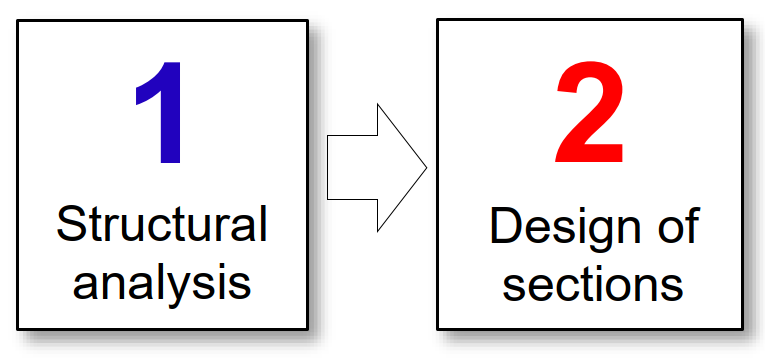
      Identify the vocabulary and the sequential logic “structural analysis → design of cross-sections” to better read and understand the code.

      This article deciphers the precise semantics used in EC2 — analysis, design, actions, effects, mean and characteristic values — and shows how these definitions structure the entire code.

      It clarifies the two-step process (structural analysis followed by cross‑section design) and describes the different regulatory material behaviour laws associated with each step.

      This conceptual basis then makes it possible to understand the boundaries between the models involved, and in particular to address the issue of deformation compatibility.

      This topic constitutes the first part of a series dedicated to the flexural behaviour of reinforced concrete beams (1/4).

      Nicolas DUBREIL
      11 mins
      Published 11 March 2026
      Version 19 March 2026
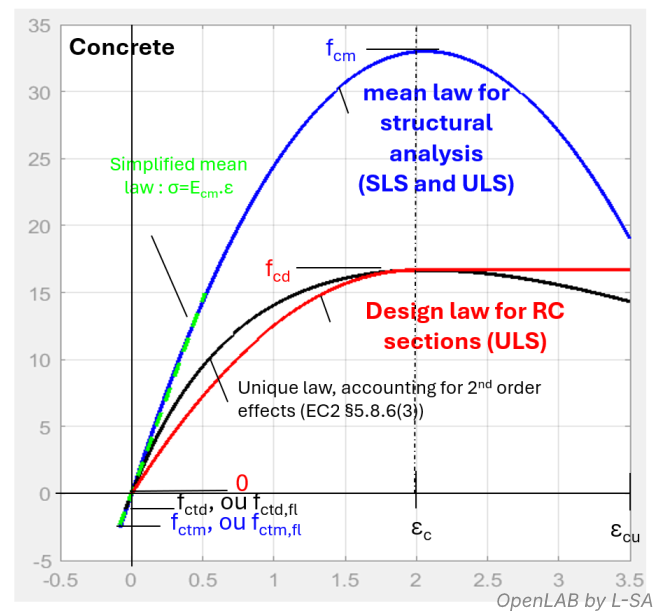
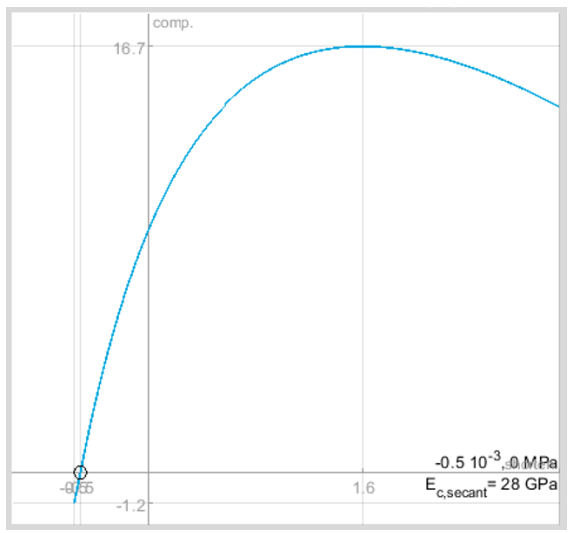
      The material laws in EC2 vary between structural analysis and cross‑section design, incorporating different levels of physical complexity in the behaviour of concrete and steel depending on the objectives pursued.

      EC2 Material Laws: Curve Linearisation and Progressive Cracking

      The material laws in EC2 vary between structural analysis and cross‑section design, incorporating different levels of physical complexity in the behaviour of concrete and steel depending on the objectives pursued.

      This article details the different behaviour laws for concrete and steel, their distinct uses (structural analysis vs cross‑section design), and their limitations.

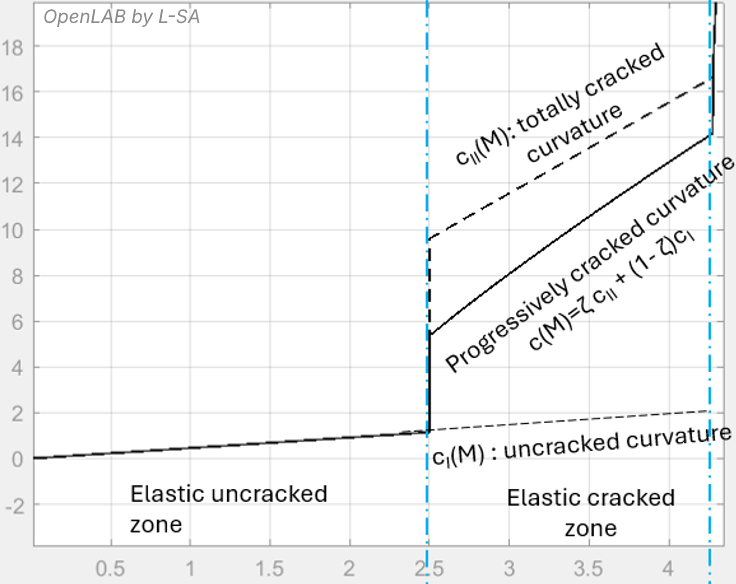
      It explores how phenomena such as plastification, cracking, or even the tensile resistance of concrete are taken into account, and clarifies the safety factors and the possibilities for linearisation or other simplifications authorised by EC2 depending on the design step.

      This topic is the second part of a series devoted to the flexural behaviour of reinforced concrete beams (2/4).

      Nicolas DUBREIL
      14 mins
      Published 11 March 2026
      Version 24 March 2026
      In hyperstatic structures, deformation compatibility dictates the exact distribution of moments — a challenge that the simplified EC2 methods only partially address.

      Hyperstatic Structures : the Unique Deformation‑Compatible Solution

      In hyperstatic structures, deformation compatibility dictates the exact distribution of moments — a challenge that the simplified EC2 methods only partially address.

      This article explains how a hyperstatic structure possesses, for each load case, a unique exact solution determined by the actual deformability of its sections and supports.

      It shows that internal forces depend closely on varying stiffness, reinforcement layout, progressive cracking and plastification, making the EC2 sequential approach sometimes insufficient.
      It also explores the conditions for nonlinear analysis, enabling the limitations of the “structural analysis → cross‑section design” framework to be overcome.

      This topic constitutes the third part of a series dedicated to the flexural behaviour of reinforced concrete beams (3/4).

      Nicolas DUBREIL
      8 mins
      Published 11 March 2026
      Version 19 March 2026
      Elastic structural analysis, limited redistribution, and plastic analysis. Study on an example, verification of ductility, and the limits of these models

      Continuous Beams : Plastic Hinges, Redistribution, and the Limits of Elastic Analyses

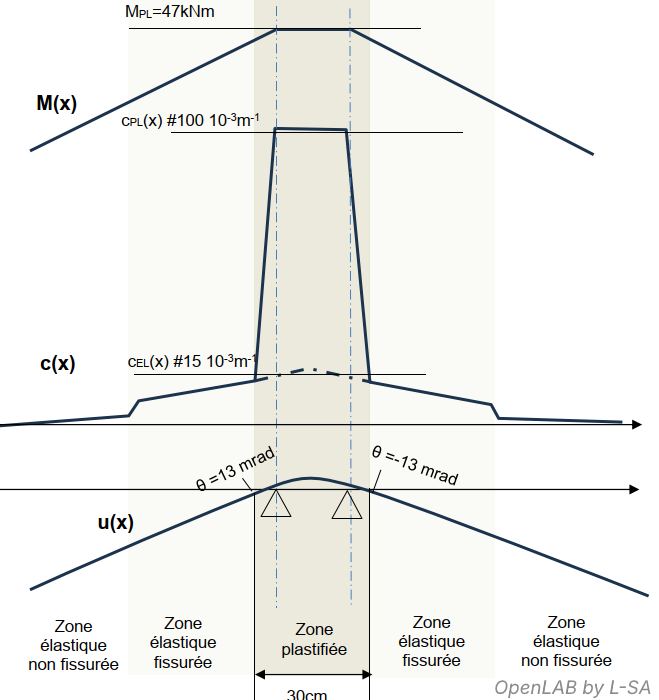
      Elastic structural analysis, limited redistribution, and plastic analysis. Study on an example, verification of ductility, and the limits of these models

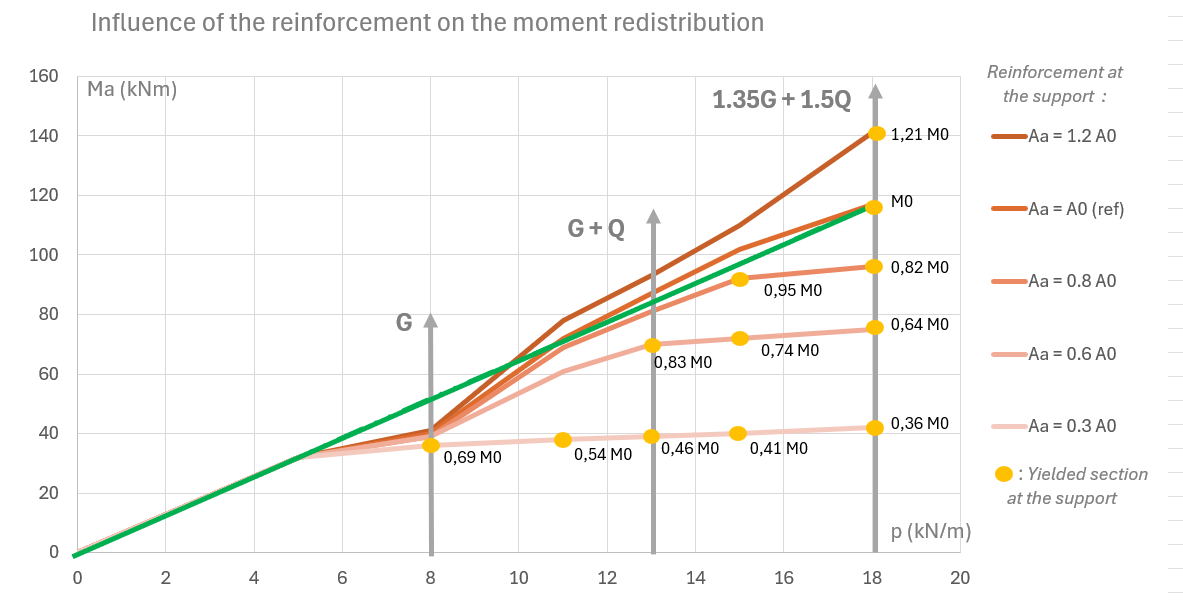
      This article presents the four structural analysis methods proposed by Eurocode 2 for continuous beams, and shows how simplified approaches (elastic, limited redistribution, plastic) deliberately bypass the pursuit of the exact solution.

      It explains the mechanisms of hinge formation, the conditions for valid redistribution, the verification of plastic rotation capacity, and the biases of linear models when cracking and stiffness loss become predominant.
      Finally, it highlights possible discrepancies between simplified analysis and actual behaviour, especially regarding deflection, second‑order effects, and redistribution at SLS.

      This topic is the final part of our series dedicated to the flexural behaviour of reinforced concrete beams (4/4).

      Nicolas DUBREIL
      13 mins
      Published 11 March 2026
      Version 20 March 2026
      Analysis of a little‑known axial phenomenon: the elongation of simply‑bent RC beams under gravity loads, a direct consequence of reinforced‑concrete behaviour.

      A reinforced‑concrete beam elongates under gravity load!

      Analysis of a little‑known axial phenomenon: the elongation of simply‑bent RC beams under gravity loads, a direct consequence of reinforced‑concrete behaviour.

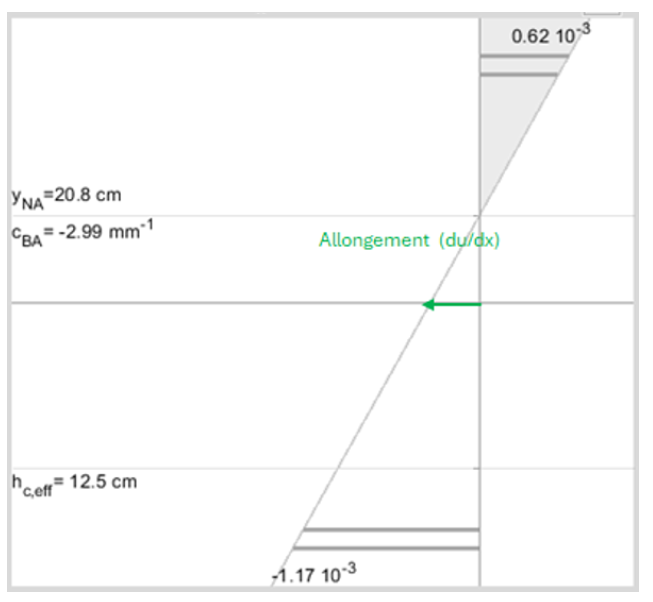
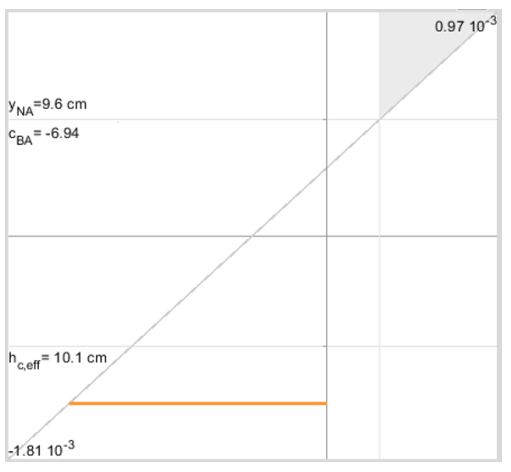
      This article introduces the first axial effect observable in flexural reinforced‑concrete elements: the elongation of simply‑bent beams under gravity loads.
      This phenomenon—often overlooked despite being non‑negligible—results directly from the fundamental behaviour of reinforced concrete, especially once cracking develops. Understanding it is essential before rigorously addressing the effects of thermal expansion and shrinkage.
      It forms the first part of the series “Axial behaviour of flexural reinforced‑concrete elements” (1/4). 

      Nicolas DUBREIL
      6 mins
      Published 06 March 2026
      Version 19 March 2026
      Thermo‑mechanical analysis of RC sections: constitutive laws, effects of thermal expansion and thermal gradients, and cases where EC2 requires their consideration.

      Calculation of thermal expansion and thermal gradient effects

      Thermo‑mechanical analysis of RC sections: constitutive laws, effects of thermal expansion and thermal gradients, and cases where EC2 requires their consideration.

      This article examines the thermo‑mechanical behaviour of reinforced‑concrete members subjected to thermal expansion or thermal gradients, based on the assumptions of Eurocode 2.
      It first analyses how the constitutive laws of concrete and steel are modified and how the mechanical diagrams of RC sections (strains, stresses, internal forces) evolve under thermal actions.
      The article then reviews the regulatory situations in which thermal effects must be considered, illustrates the physical behaviour that can be observed, and presents the gravity/thermal concomitances that may become governing.
      This is the second part of the series “Axial behaviour of flexural reinforced‑concrete elements” (2/4). 

      Nicolas DUBREIL
      8 mins
      Published 06 March 2026
      Version 19 March 2026
      Analysis of concrete shrinkage, the induced self‑stresses, the differences with thermal effects, and the conditions for applying EC2 formula (7.21).

      Calculation of concrete shrinkage effects

      Analysis of concrete shrinkage, the induced self‑stresses, the differences with thermal effects, and the conditions for applying EC2 formula (7.21).

      This article examines the mechanical behaviour of reinforced concrete subjected to shrinkage, highlighting the fundamental differences between shrinkage and thermal effects, and introducing the notion of self‑stresses that develop within the section.
      It then analyses how the constitutive laws of concrete and steel are modified and how the mechanical diagrams of a reinforced‑concrete section (geometry, strains, stresses, internal forces) evolve under shrinkage.
      Finally, the article clarifies the conditions under which Eurocode 2 formula (7.21)—used to estimate the curvature of a flexural member due to shrinkage—can be validly applied.
      This contribution forms the third part of the series “Axial behaviour of flexural reinforced‑concrete elements” (3/4).
       

      Nicolas DUBREIL
      8 mins
      Published 06 March 2026
      Version 19 March 2026
      Synthesis of simultaneous axial effects: shrinkage, thermal actions, gravity-induced elongation, cracking, and the limitations of elastic analyses

      Restrained shrinkage and thermal expansion: concomitance and cracking

      Synthesis of simultaneous axial effects: shrinkage, thermal actions, gravity‑induced elongation, cracking, and the limitations of elastic analyses.

      This final part broadens the analysis of axial effects by considering the concomitance between shrinkage, thermal expansion and gravity‑induced elongation, as well as the impact of cracking.
      The article highlights several points of vigilance regarding the elastic structural analysis of axial effects, and proposes that shrinkage studies should systematically include the effect of gravity‑induced elongation, and that thermal analyses at the characteristic SLS should jointly include shrinkage + gravity effects.
      It constitutes the fourth part of the series “Axial behaviour of flexural reinforced‑concrete elements” (4/4). 

      Nicolas DUBREIL
      9 mins
      Published 06 March 2026
      Version 19 March 2026

      Page 1 of 2

      • 1
      • 2

       Would you like to learn more about the author and the context of each article, share your reactions, and contribute to the discussions with the community around each topic? Join the OpenLAB community now !


      The content published on OpenLAB is the sole responsibility of its authors. It is provided for informational purposes only, without any guarantee of accuracy, completeness, or timeliness. Its use is entirely at the user’s own risk.
      © 2026 Laboratoire Structures et Applications / OpenLAB members – All rights reserved. Legal Notice – Privacy Policy – OpenLAB Terms of Use – contact@l-sa.eu

      • Categories
        • Scientific and Technical Articles – Community Contributions
        • Site Feedback – Structural Project Case Studies and Lessons Learned
        • Calculation Notes – Real Cases and Applications
        • Downloadable Calculation Tools – Utilities and Methodological Guides
        • Professional Insights – Shared Contributions and Industry Watch
      • Themes
        • Structural materials
          • Soil-Geotechnics
          • Concrete
          • Reinforced concrete
          • Prestressed concrete
          • Steel
          • Steel-concrete composite
          • Aluminium
          • Cable
          • Timber
          • Timber-concrete composite
          • Timber-steel composite
          • Stone
          • Earth
          • Other material
        • Types of works
          • Ground reinforcement
          • Special foundation
          • Foundation
          • Slab-mat suspended slab
          • Retaining wall
          • Framework
          • Column
          • Beam
          • Wall
          • Floor slab
          • Facade
          • Structure (roof)
          • Roof
          • Other structure
        • Study phases
          • Assumptions
          • Design
          • Structural analysis and sizing
          • Construction provisions
          • Drawing
          • Description-specification
          • Construction monitoring
          • Diagnosis
          • Rehabilitation
          • Other study
        • Types of analysis
          • Gravity load analysis
          • Bracing
          • Seismic analysis
          • Fire scenario analysis
          • Deformation
          • Vibration
          • Durability
          • Environmental impact
          • Pathology
          • Other analysis
      • Featured
      • About
        • The OpenLAB project
        • OpenLAB Terms and Conditions
        • Contact us
        • L-SA
      • Login