
 FR
FR 
Identify the vocabulary and the sequential logic “structural analysis → design of cross-sections” to better read and understand the code.
This article deciphers the precise semantics used in EC2 — analysis, design, actions, effects, mean and characteristic values — and shows how these definitions structure the entire code.
It clarifies the two-step process (structural analysis followed by cross‑section design) and describes the different regulatory material behaviour laws associated with each step.
This conceptual basis then makes it possible to understand the boundaries between the models involved, and in particular to address the issue of deformation compatibility.
This topic constitutes the first part of a series dedicated to the flexural behaviour of reinforced concrete beams (1/4).
The Eurocode 2 text: essential semantics to decipher
The text of Eurocode 2 uses precise semantics regarding several key terms, used throughout its chapters. Correctly identifying these keywords, and understanding their specific meaning, significantly improves comprehension of the articles, the overall logic, and more generally the use of the code.
The following part of this chapter offers insight into several fundamental notions addressed “in the text”.
“analysis” and “design”
Eurocode 2 is built on the assumption that the study of structural systems can be broken down into two steps, carried out successively:
- Step 1, called “structural analysis”
- Step 2, called “design of cross sections” (EC2 §5.1.1 (1)P)
Here we see an example of a non‑intuitive vocabulary: the distinction made in Eurocode 2 between “analysis” and “design” could have been defined the other way around, leading to “structural design” for step 1 and “section analysis” for step 2.
Once the meaning of the term “design” in Eurocode 2 is known, it becomes easy to understand that all quantities indexed “d” (design) relate to step 2 (cross‑section design) and not to the determination of internal forces.
The choice of the word “design” is another example of a non‑intuitive decision, since “design” can be interpreted more broadly as “conception”, extending beyond mere cross‑section calculation.
“internal forces and moments”, “loads”, “actions” and “effects”
In Eurocode 2, a boundary condition or a mechanical action applied to a structural system, such as:
- A load
- An imposed displacement
- A thermal variation
is an “action”.
In the text, the term “internal forces and moments” refers to the “effect” of these actions on the structural system — meaning the internal force vector of a beam or structural element at a given section, or one of its components:
- Bending moment
- Torsional moment
- Shear force
- Normal force
“characteristic value” and “mean value”
The distinction between “characteristic” (“characteristic”) and “mean” (“mean”) is another important example. As we will see later, the characteristic value of a material property in Eurocode 2 is much lower than its mean value and is used in cross‑section design, while the mean value is used in structural analysis.
We develop below two complementary examples taken from Eurocode 2 illustrating the importance of identifying keywords correctly.
Tensile flexural strength (design): fctd,fl
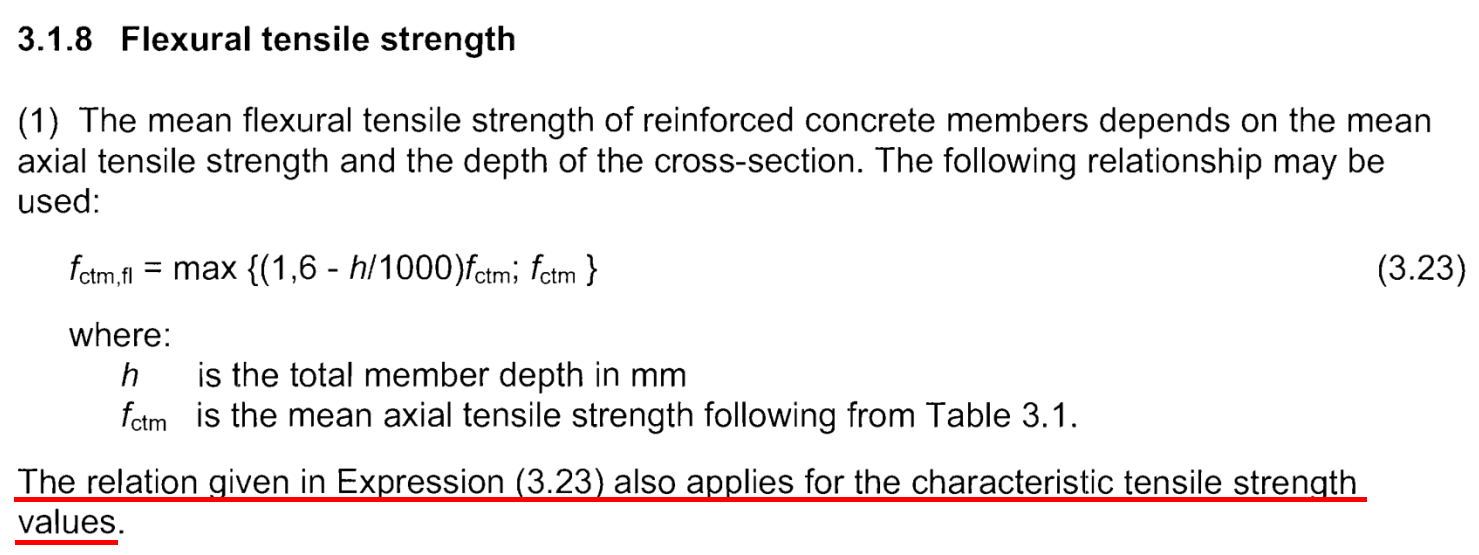
This excerpt concerns the tensile strength of concrete in tension. The sole purpose of the underlined sentence is to indicate the possibility of extending formula (3.23), given for the mean value, to the “characteristic” value of concrete tensile strength.
This means that one may use a value fctk0,05,fl more favourable than fctk0,05, and consequently also fctd,fl, in cases where fctm,fl applies — i.e., in pure bending or combined bending and compression. This rule favourably influences the anchorage lengths of reinforcing bars in beams, and the tensile resistance of slender columns.
Mean material properties
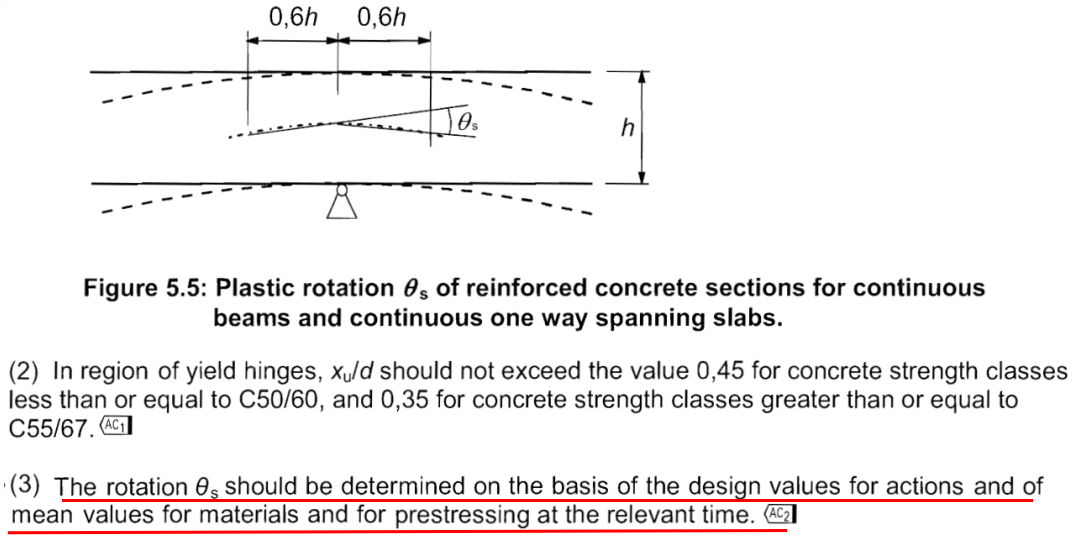
This excerpt concerns the verification of ductility in a plastic hinge. Although plastic hinges are only considered at ULS, this sentence reminds the reader that the computation of rotations, strains and displacements must be carried out during structural analysis under ULS load combinations, using Ecm, fctm, and not fcd or Ecd (see discussion below on structural analysis).
Eurocode 2 design: structural analysis followed by cross‑section design
Let us now examine the Eurocode 2 design process, based sequentially on two steps.
Chapter 5, titled “Structural analysis”, deals with step 1, whereas chapter 6, “Ultimate limit state”, which could also be titled “Cross‑section design at ULS”, deals with step 2.

Throughout this series, we will refer to “step 1” and “step 2”.
Structural analysis: determining the most probable internal forces {N, T, M}
Structural analysis takes as input:
- The overall geometry of the system
- The system’s boundary conditions:
- Loads
- Supports
- The material behaviour laws
And seeks to determine:
- The load path and the most probable internal forces {N, T, M} in all sections of the concrete members
- The most probable strains and displacements of all structural elements
- The most probable stresses in the materials
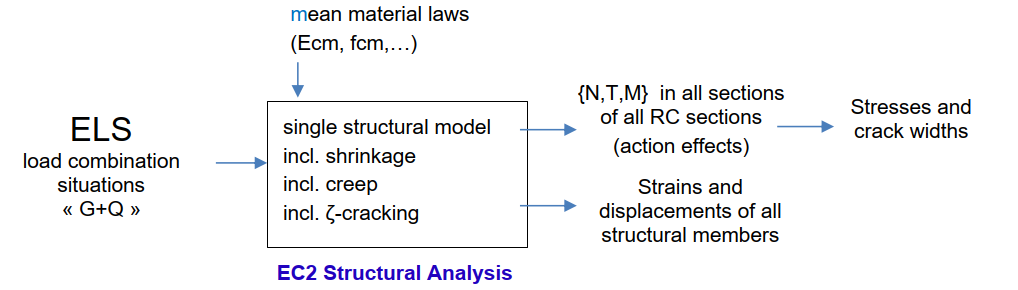
Obtaining realistic estimates requires selecting the most probable behaviour laws. Structural analysis in EC2 therefore uses the mean behaviour laws (Ecm, fcm, fctm), not the lower, design laws (Ecd, fcd, fctd).
These mean laws must be used for all limit states: SLS or ULS (EC2 §5.4 iii; EC2 figure 3.2).
Likewise, structural analysis should ideally account for all effects influencing stiffness, strain, stress and internal forces, as all these are tied together by global deformation compatibility.
Thus — in principle — shrinkage and creep must be considered at both ULS and SLS (EC2 §5.4(3)).
The tensile behaviour of concrete, and even the gradual formation of cracking should also be considered and, e.g. using the ζ‑factor method (§7.4.3(3)).
Finally, second‑order effects must be considered at ULS if significant, and are often neglected at SLS.
It is important to note that — except where negligible — EC2 intends for a single structural analysis model, using the same material laws, to be used for determining internal forces and strains, for all limit states: SLS, ULS, GEO and EQU.
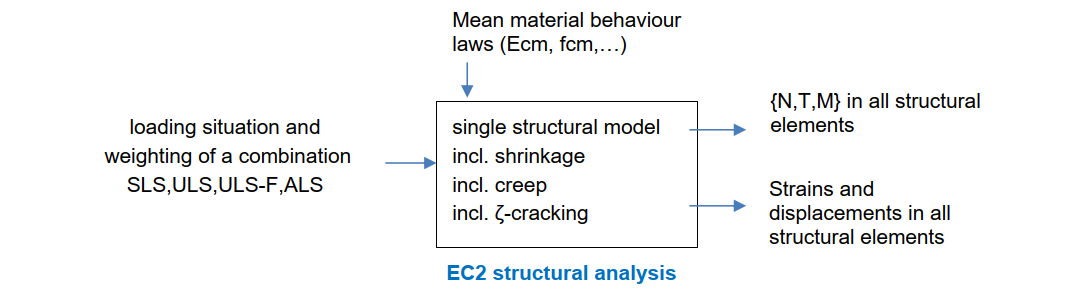
An experienced engineer familiar with Eurocode 2 practice might object to this statement of a “single structural analysis model” and argue that SLS combinations call for a structural analysis based on elastic behaviour models, whereas ULS combinations require a structural analysis based on bilinear or parabola‑rectangle behaviour models. This perception stems from an operational shortcut rooted in EC2 practice: it is true for section design (step 2), but false for structural analysis (step 1).
The idea of a “single structural analysis model” may also seem surprising for another reason: in practice, engineers often adopt a linear elastic uncracked model for global analysis, then a different model—integrating for instance ζ‑cracking—for deflection verification. The structural analysis model therefore appears to evolve from ULS to SLS. Here again, this is a shortcut. For practical reasons, Eurocode 2 §§5.4, 5.5 and 5.6 allow a drastic simplification of the structural analysis model leading to the internal forces N, V, M at ULS, but this is an exception to the general principle of a unique structural analysis model described above. (See the section “Simplifications allowed for ULS structural analysis” on this topic.)
Overall, the reminders provided in this article are intended to support a global understanding of the code, to reposition the successive building blocks of Eurocode 2 from general principles to the practical simplifications that are allowed, so as to better relate all parts of the text to each other and to better understand the application of Eurocode 2 to use‑cases that fall outside routine practice.
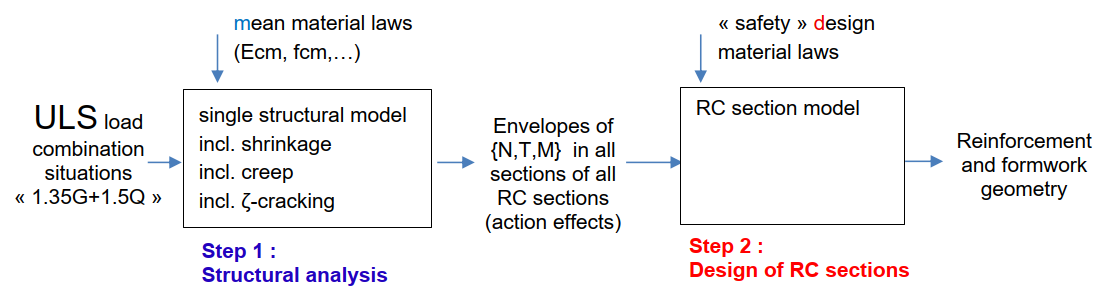
Cross‑section design: integrating adequate safety in resistance
“Cross‑section design”, in the EC2 sense, means:
- Designing the reinforcement and sometimes the formwork geometry of a reinforced concrete cross‑section
- subjected to the maximum internal forces {N, T, M}, previously obtained from structural analysis under all ULS load combinations
- using design material laws — no longer mean laws, but safety‑oriented laws for concrete and steel
The safety‑oriented material laws are called design laws and carry the subscript “d”. They are derived via partial safety factors depending on the ULS type: ULS, EQU, GEO (EC2 §2.4.2.4).
Verifying the structure at SLS
The vocabulary used in EC2 reflects the philosophy that:
- design is carried out at ULS (step 1 under ULS loads, followed by step 2), meaning sections are dimensioned for strength using design material laws
- verification is carried out at SLS, checking deformations, displacements, vibrations, stresses and crack widths, using the same structural analysis model, the SLS loads, and the fully known sections
Simplifications allowed for structural analysis at ULS
The first use of the structural analysis model (in the EC2 sense) is thus to determine ULS internal forces.
However, as previously described, the two‑step process:
- structural analysis: determine internal forces
- cross‑section design
does not work explicitly.
Indeed, structural analysis should account for progressive cracking and plastification to estimate the most realistic structural behaviour and internal forces.
This implies that the sections — geometry and reinforcement — must already be known, meaning cross‑section design must precede analysis. Thus the process must be iterative, repeated until convergence: this is nonlinear analysis (EC2 §5.7).
However, Eurocode 2 includes a §5.4 with extremely strong simplifications that make ULS analysis much simpler and restore the sequential approach for routine design.
The vocabulary in this paragraph is again a key to interpretation:
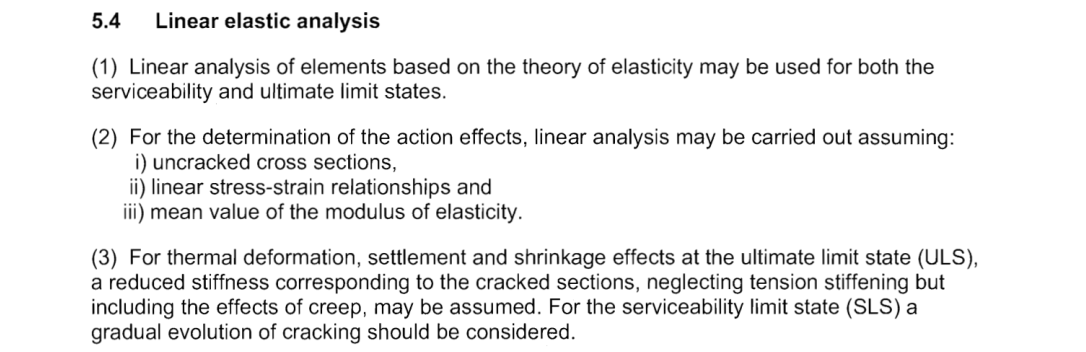
Although the French EC2 version uses the word “design” (“calcul”), point (1) actually refers to structural analysis.
By allowing a linear elastic structural analysis, EC2 permits a simplification of material laws:
- The general mean stress‑strain curve σ=f(ε) of concrete may be replaced by an infinite linear elastic curve in compression : σ = Ec ε
- The bilinear steel law may also be simplified to σ = ES ε
This simplification is allowed:
- at SLS, where the approximation is acceptable given the range of strains
- at ULS, where plastification of materials may be entirely neglected for analysis — a strong simplification
Point (2) adds assumptions allowed only for “the determination of internal forces”, i.e., for “ULS structural analysis”:
- Sections may be assumed uncracked
- The elastic modulus must be the mean modulus Ecm
Although (2) mentions both concrete and steel, once the section is considered uncracked, the presence of steel is typically neglected in routine structural analysis.
These assumptions (§5.4) give coherence to the code’s logic: structural analysis becomes an autonomous and preliminary step before cross‑section design, and can be carried out with a global model of reasonable complexity, made feasible numerically thanks to the linear‑elastic hypothesis.
§5.5 (“limited redistribution”) and §5.6 (“plastic analysis”) are variants of the linear elastic model from §5.4, introducing simplified plastification mechanisms in limited locations, improving ULS analysis while preserving an explicit step‑by‑step procedure (step 1 → step 2 without iteration).
The third article of this series will introduce the conditions for exact mechanical resolution in Eurocode 2, exploring nonlinear analysis (§5.7).
In the next article of this series, we will focus more specifically on modelling concrete and steel behaviour according to Eurocode 2, depending on the phases: EC2 Material Laws: Curve Linearisation and Progressive Cracking
