
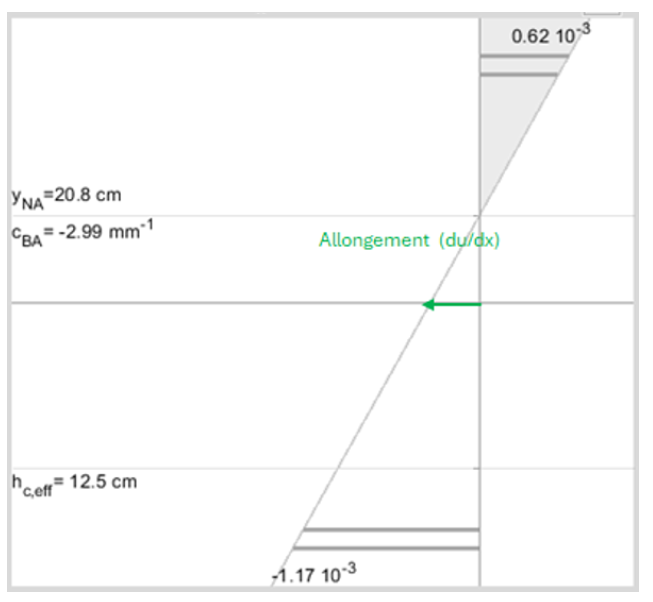
Analysis of a little‑known axial phenomenon: the elongation of simply‑bent RC beams under gravity loads, a direct consequence of reinforced‑concrete behaviour.
This article introduces the first axial effect observable in flexural reinforced‑concrete elements: the elongation of simply‑bent beams under gravity loads.
This phenomenon—often overlooked despite being non‑negligible—results directly from the fundamental behaviour of reinforced concrete, especially once cracking develops. Understanding it is essential before rigorously addressing the effects of thermal expansion and shrinkage.
It forms the first part of the series “Axial behaviour of flexural reinforced‑concrete elements” (1/4).
- Nicolas DUBREIL
- 6 mins
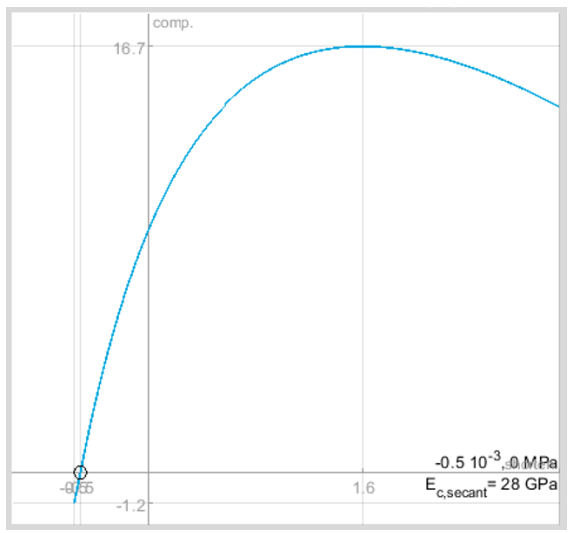
Thermo‑mechanical analysis of RC sections: constitutive laws, effects of thermal expansion and thermal gradients, and cases where EC2 requires their consideration.
This article examines the thermo‑mechanical behaviour of reinforced‑concrete members subjected to thermal expansion or thermal gradients, based on the assumptions of Eurocode 2.
It first analyses how the constitutive laws of concrete and steel are modified and how the mechanical diagrams of RC sections (strains, stresses, internal forces) evolve under thermal actions.
The article then reviews the regulatory situations in which thermal effects must be considered, illustrates the physical behaviour that can be observed, and presents the gravity/thermal concomitances that may become governing.
This is the second part of the series “Axial behaviour of flexural reinforced‑concrete elements” (2/4).
- Nicolas DUBREIL
- 8 mins
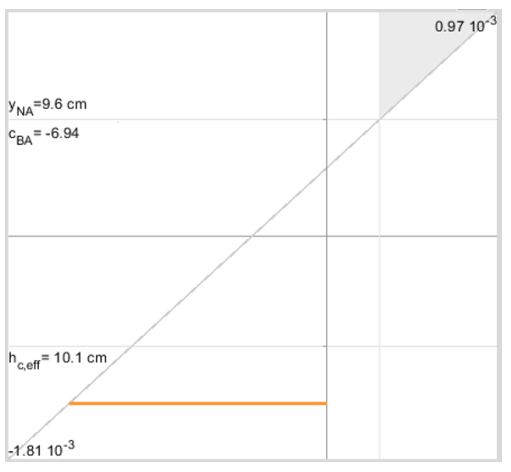
Analysis of concrete shrinkage, the induced self‑stresses, the differences with thermal effects, and the conditions for applying EC2 formula (7.21).
This article examines the mechanical behaviour of reinforced concrete subjected to shrinkage, highlighting the fundamental differences between shrinkage and thermal effects, and introducing the notion of self‑stresses that develop within the section.
It then analyses how the constitutive laws of concrete and steel are modified and how the mechanical diagrams of a reinforced‑concrete section (geometry, strains, stresses, internal forces) evolve under shrinkage.
Finally, the article clarifies the conditions under which Eurocode 2 formula (7.21)—used to estimate the curvature of a flexural member due to shrinkage—can be validly applied.
This contribution forms the third part of the series “Axial behaviour of flexural reinforced‑concrete elements” (3/4).
- Nicolas DUBREIL
- 9 mins
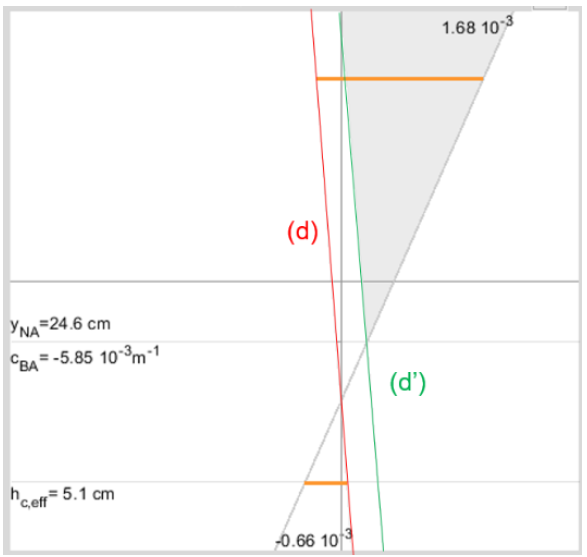
Synthesis of simultaneous axial effects: shrinkage, thermal actions, gravity‑induced elongation, cracking, and the limitations of elastic analyses.
This final part broadens the analysis of axial effects by considering the concomitance between shrinkage, thermal expansion and gravity‑induced elongation, as well as the impact of cracking.
The article highlights several points of vigilance regarding the elastic structural analysis of axial effects, and proposes that shrinkage studies should systematically include the effect of gravity‑induced elongation, and that thermal analyses at the characteristic SLS should jointly include shrinkage + gravity effects.
It constitutes the fourth part of the series “Axial behaviour of flexural reinforced‑concrete elements” (4/4).
- Nicolas DUBREIL
- 11 mins
