
 FR
FR 
This article presents the benefits of a nonlinear approach for the analysis of reinforced concrete line elements, intended to determine the unique solution of the mechanical problem — when it exists — by enforcing flexural and axial deformation compatibility at every point along the member.
Inspired by the General Method and fully covered by Eurocode 2, this approach, referred to as the “Integral General Method” or IGM, opens up possibilities for analysing and optimising many common situations, from slender columns to continuous members in combined bending and compression.
The practical analysis of reinforced concrete beams and columns
The calculation methods for line elements under normal actions are fundamental to reinforced concrete engineering. They are used not only for the design of columns and beams, but also walls and slabs, and therefore for most elements of a typical building or civil engineering structure.
However, in both the former BAEL practice and today’s Eurocode 2, the approaches to beams and columns are documented and taught separately: column analysis on one side, continuous beam analysis on the other.
This dichotomy sometimes creates “blind spots” in structural analysis, particularly in intermediate configurations.
Moreover, in current practice, explicit verification of deformation compatibility is often bypassed when deriving internal forces, leading to an approximate resolution of the governing equationsNOTE, which can be problematic in certain cases.
Uniqueness of the solution
However, a reinforced concrete line element for which the following are known:
- the full set of sections along the member: geometry and reinforcement, potentially varying with the position,
- the initial geometric imperfection along the member (construction tolerance or intentionally imposed camber),
- the complete support conditions: at the ends and possibly at intermediate locations, with any degree of redundancy,
- the full set of loads, axial or transverse, point or distributed, applied at the ends or at intermediate locations,
- the nonlinear material laws for concrete and steel,
admits at most one unique solution that satisfies the whole system, notably the compatibility of axial and flexural deformations.
This remains true when second‑order effects are included.
The Integral General Method
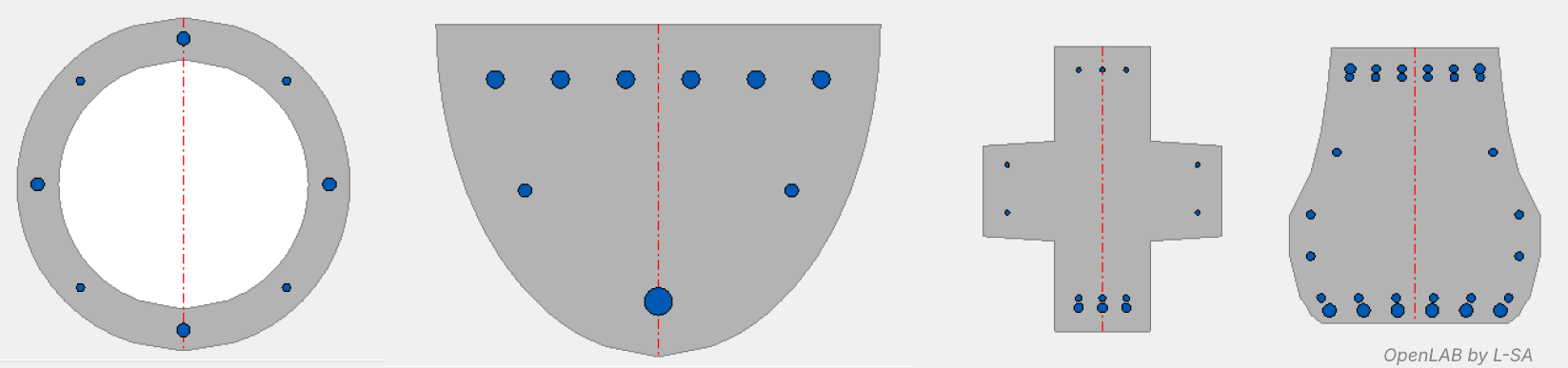
The Integral General Method (IGM) for the analysis of reinforced concrete beams and columns seeks to determine this unique solution, when it exists, for any member symmetric with respect to a plane, with actions and support conditions contained in that plane (normal or tangential).
It therefore no longer requires circumventing the compatibility check: compatibility is enforced exactly at every point. The distinction between external and internal eccentricity also disappears, as both notions coincide continuously along the element.
The Integral General Method may therefore be considered, from different viewpoints, as:
- A generalisation of the General Method of Eurocode 2. Indeed, the General Method of EC2, presented for slender columns, allows deformation compatibility to be checked at several sections (EC2 §5.8.6). The method proposed here enforces compatibility continuously along the whole member.
- A numerical realisation of the “adaptation” phenomenon in concrete. This intuitive principle, taught since the early days of reinforced concrete, states that RC behaves according to how it was analysed and reinforced. The IGM provides a means to test this principle, and to identify where it holds and where it reaches its limits.
- A bridge between column and beam analysis, extending the domain of each and removing the “blind spots” that previously existed (e.g. multi‑supported columns, ELS deformation of slender members).
- A bridge between ELS and ULS section modelling, which until now have been treated separately. In the proposed method, the concrete and steel material laws are nonlinear and evolve with the level of action, using the same framework for ELS and ULS verification. Only the applied loads and safety factors differ.
A method consistent with Eurocode 2
Initially conceived for reinforced concrete columns in arbitrary loading, deformation and boundary conditions, the IGM is a practical numerical and mathematical proposal that fits fully within the current theoretical framework of Eurocode 2.
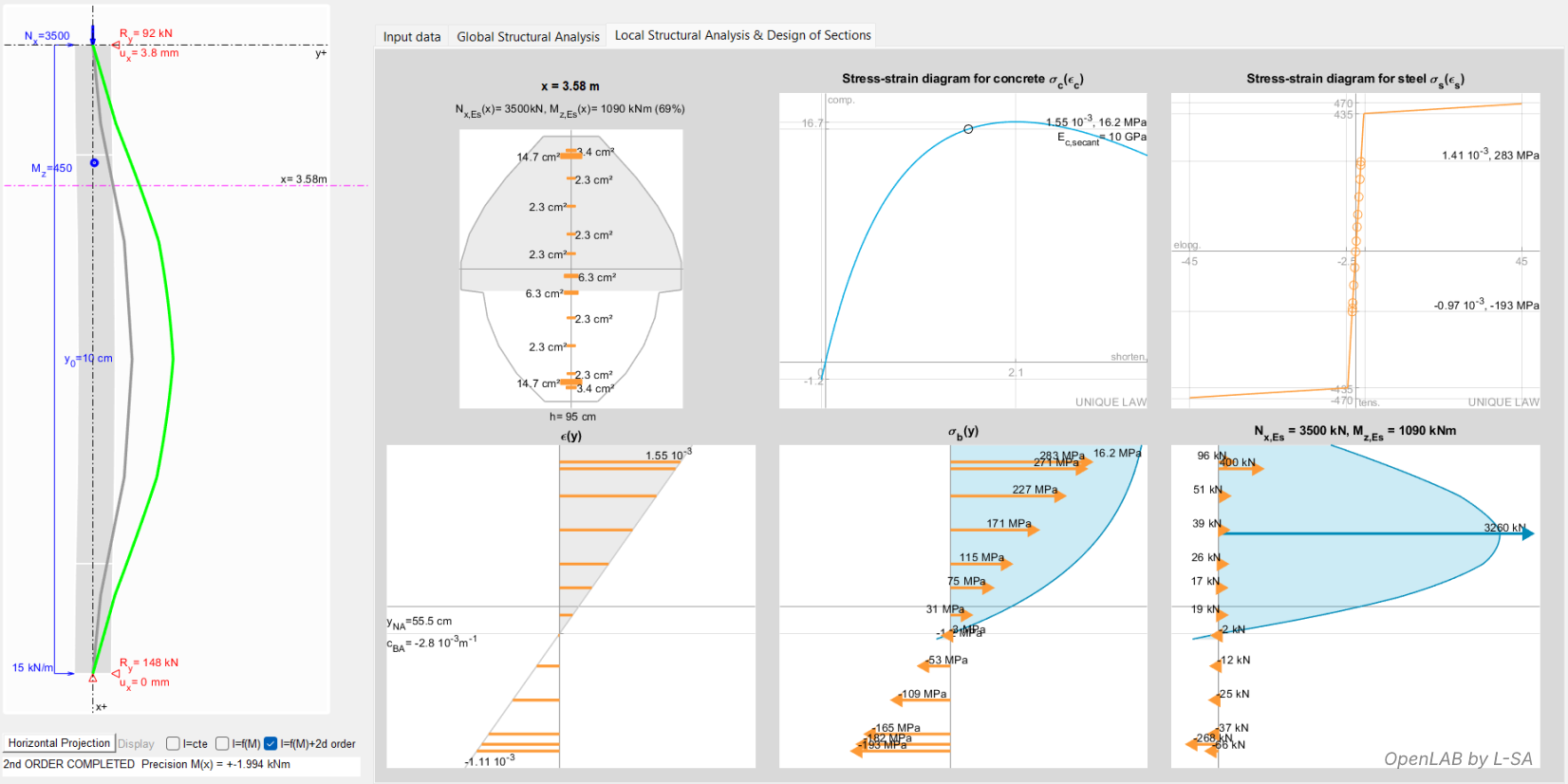
Integral General Method applied to a column restrained out of plane, with varying section and initial imperfection. Local representation of strains, stresses, internal forces and reinforcement along the member.
As mentioned previously, it determines the equilibrium and deformation‑compatibility conditions in every section, explicitly. It therefore generalises the method set out in EC2 §5.8.6(6):

Extract from EC2 §5.8.6(6)
The IGM therefore overcomes several limits and risks of the simplified option of the General Method (MG1), which studies flexural deformation compatibility only at one presumed “critical” section (see also our dossier on the MG1 method and its usage limitations).
For columns, IGM determines all second‑order effects propagated to the supports, while being simpler, more accurate, and applicable over a wider domain. It avoids several assumptions that are sometimes laborious and error‑prone for the engineer, such as:
- assuming a “representative” final deflected shape,
- estimating an equivalent buckling length,
- locating the critical section,
- selecting the correct first‑order moment at that section,
- determining the correct additional eccentricity to apply.
Eurocode 2 also explicitly allows such methods in a broader context beyond columns, in EC2 §5.7(1):

Extract from EC2 §5.7(1)
The IGM matches this description exactly: it is nonlinear, applies to both SLS and ULS, works at first and second order, and applies not only to columns but also to the verification and optimisation of beams and any continuous member in combined bending and axial load.
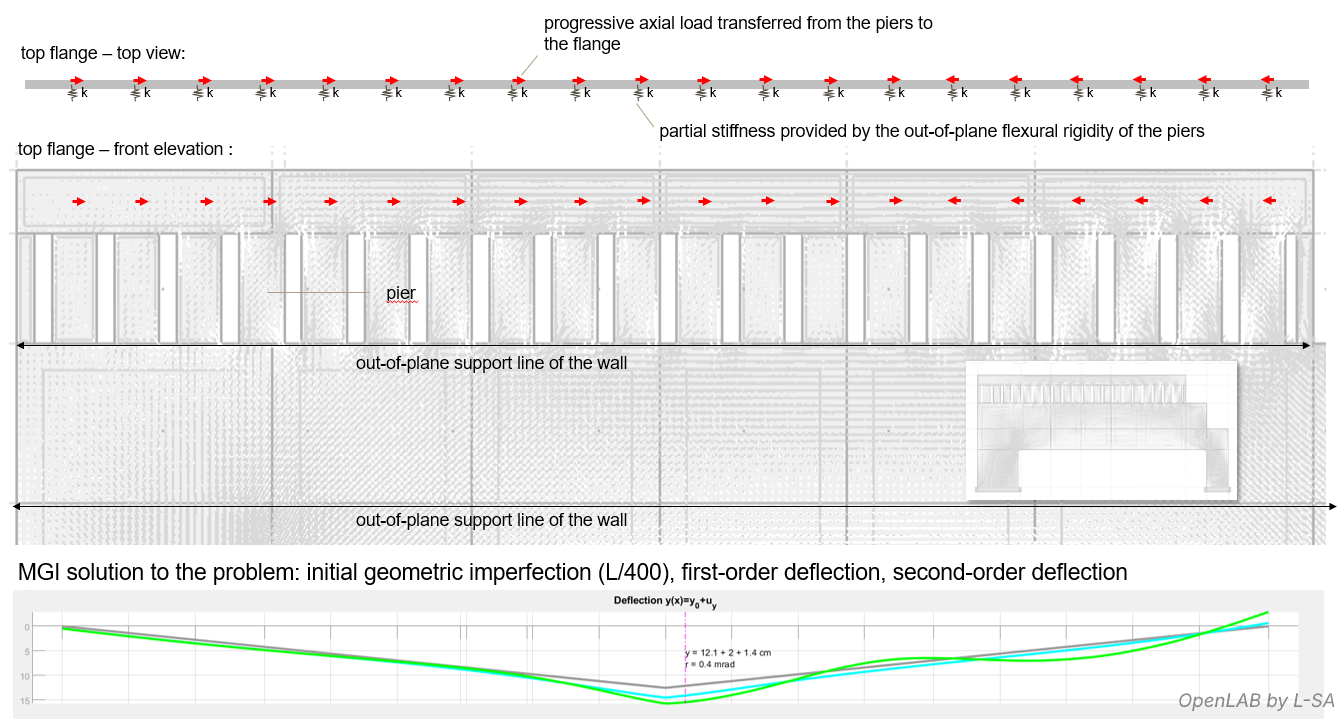
Integral General Method applied to the lateral‑torsional stability of the upper flange of a wall‑beam not restrained out of plane. Progressive axial load and out‑of‑plane elastic stiffness.
Flexural and axial deformation compatibility
The deformation‑compatibility concept in Eurocode 2 concerns primarily flexural compatibility, i.e. the coherence between curvatures obtained from classical beam theory and those obtained from reinforced‑concrete section checks.
IGM verifies this flexural compatibility, but also the axial compatibility, i.e. the elongation or shortening of fibres, linked to concrete behaviour, cracking and plasticity. This is particularly important when analysing shrinkage, thermal effects or thermal gradients on RC members in combined bending and axial load.
Accuracy of the results

When handling a combination‑lock padlock, finding the one correct code is tedious. But once a code is proposed, checking whether it is correct is easy.
This logic also applies to the problem solved by IGM: although determining the unique solution is not straightforward, once the extreme‑fibre strains ε are known at each position, it becomes very easy to verify the correctness of the solution:
- on one hand, the ε values at the two extreme fibres give the concrete and steel stresses, and therefore the bending moment and axial force at each point. One can then differentiate twice to check point loads and distributed loads satisfy equilibrium;
- on the other hand, the ε values directly give the curvature at each location, which can be integrated twice to obtain the final deflection and verify all displacement boundary conditions, including second‑order effects.
The philosophy of the IGM tool
The IGM therefore provides all results along the element, which can then be checked easily, for example in a spreadsheet.
In practice, its implementation offers explicit navigation ergonomics and a graphical representation system of all results, expressed in the language of the engineer, enabling not only verification of the calculations but also understanding of the physical phenomena.
The engineer may at any moment inspect curve profiles, physical magnitudes, near‑neighbour relationships, the evolution of phenomena along the element, or compare first‑order and second‑order effects on deformations, internal forces and support reactions.
This physical representation, combined with the very short computation times, aims to facilitate the iterative work of analysis, design and optimisation of the engineer, taking into account non‑computational constraints such as formwork options, bar categories, minimum detailing rules, etc.
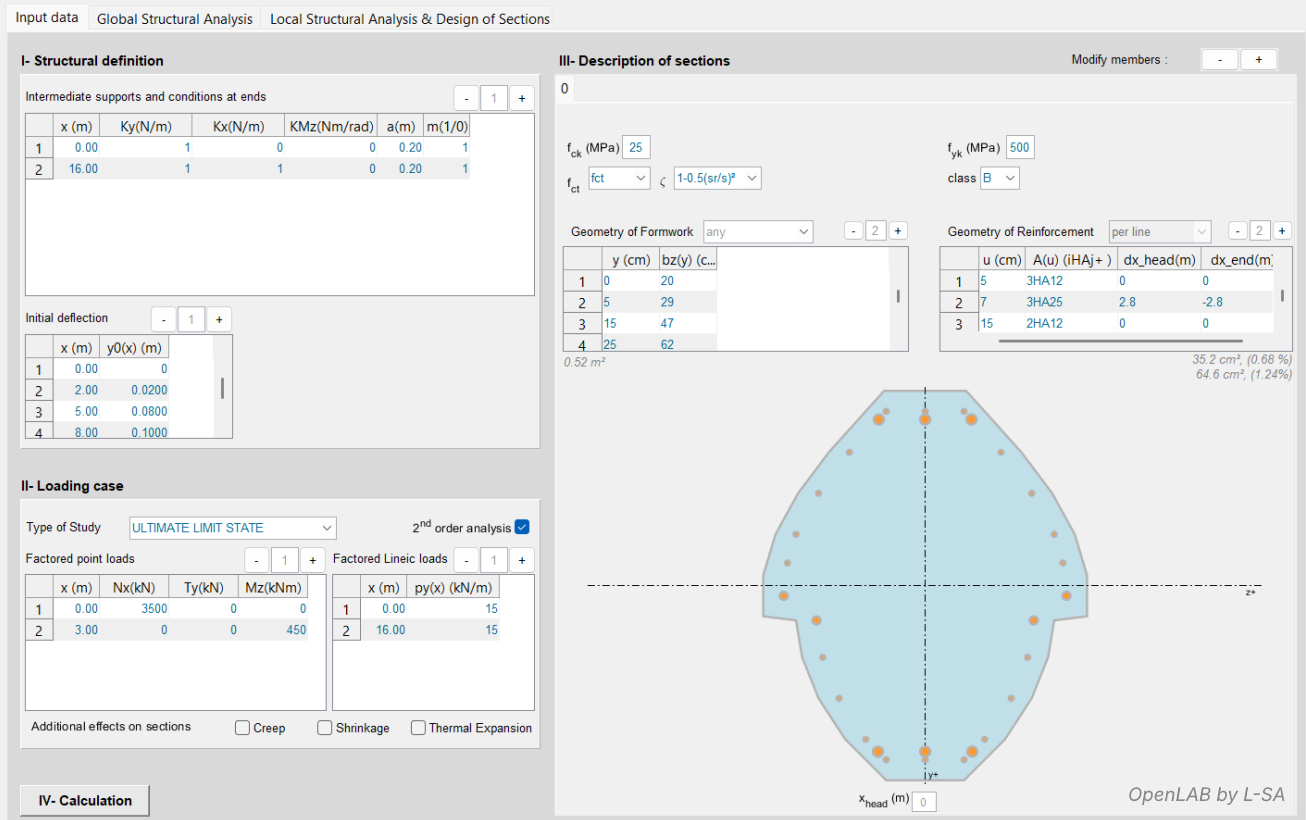
Input‑data interface of the Integral General Method implementation tool
The IGM tool is not intended to replace software dedicated to rapid and automated processing of routine cases in structural analysis. Its purpose is different: to provide a more complete, more controlled and more transparent understanding of situations where standard simplifications reach their limits and where a refined analysis can bring significant added value to the project.
Accordingly, IGM does not aim to automate combinations, envelopes or BIM interfaces: its philosophy is based on the full control, by the engineer, of the model, the assumptions and the interpretation of results.
Application fields of the IGM
In general, IGM can be used for:
- The analysis of continuous columns and continuous beams in combined bending and compression, including second‑order effects (e.g. basement parking slabs acting as struts),
- The compatibility verification of any continuous beam for a given reinforcement layout, without restricting redistribution or introducing plastic hinges,
- The optimised design of slender vertical structures with non‑symmetric loading (e.g. tall retaining walls, slender façades), including asymmetric reinforcement and bar terminations — areas where MG1 is limited to symmetric, constant‑section assumptions,
- The analysis of variable‑inertia or variable‑reinforcement columns, in civil engineering or industrial buildings,
- The study of second‑order effects in piles under arbitrary head conditions and loadings, including bar‑termination envelopes,
- The evaluation of SLS second‑order deflection of slender columns, which may impact attached façade elements,
- The calculation of crack width and total deflection, especially for continuous beams and slabs,
- The study of shrinkage, thermal expansion and thermal gradients in reinforced concrete elements.
To go further, you will find on OpenLAB several use cases of the MGI method, illustrated with images and videos, all drawn from real project situations.
The case of the partially fixed mast is particularly informative: it walks step by step through the complete application of the standard General Method (MG1) of Eurocode 2, before presenting a more direct and more complete resolution of the problem using the Integral General Method (MGI).
Feel free to log in to share your reactions, comments, or suggestions for improvement at the bottom of the article. Enjoy your reading!
NOTE: In continuous beam analysis, linear approaches are typically used that neglect the contribution of reinforcement to inertia and the reduction of section stiffness in ULS. The introduction of the theoretical plastic hinge, with simplified compatibility criteria, brings the solution closer to the exact response without actually determining it. Between the hinges, assumed to be concentrated, the member remains elastic — a double approximation. The limited redistribution approach in Eurocode 2 is a particular case of plastic analysis, where hinges are placed at supports and compatibility is checked indirectly by capping the redistribution.
For columns, assumptions are made regarding the “shape” of the final deformed configuration, reducing compatibility checks to a single “critical” section. This yields an approximate estimation of second‑order effects and critical load. This method, historically described by M. P. Faessel (Annales de l’ITBTP n°249 – September 1968), remains widely used in practice (EC2 §5.8.6(6)). Initially suited to cantilever or pinned‑pinned columns, it is extrapolated with varying levels of safety to other boundary‑condition configurations (EC2 Figure 5.7), using equivalent buckling‑length formulae. A dedicated OpenLAB article discusses the limitations of the simplified option of the Eurocode 2 General Method.
